Myanmar’s Stolen Generation: Inside the Border’s Cyber-Slave Trade
By Nhit Oo Wai
“I don’t want to do this anymore,” says Ko Kaung, his voice heavy with the quiet exhaustion of a man who knows exactly what his labor buys. “I know it destroys lives. I know it tears families apart.”
At 29, Kaung lives with a perpetually uneasy conscience. Yet, trapped between the immediate demands of family survival and a landscape devoid of alternatives, he has spent the last six months clocking into the same job.
He is employed on a construction site, but he is not building ordinary infrastructure. His days are spent laying the foundations for heavily fortified compounds designed to house; the notorious online scam syndicates currently operating along Myanmar’s borders. While Kaung does not directly defraud victims himself, he is acutely aware that his labor serves as a vital pillar keeping a criminal enterprise operational.
Since the 2021 military coup shattered Myanmar’s economic and political landscape, a cascading crisis of armed conflict and the junta’s aggressive enforcement of a mandatory military conscription law has systematically broken the future of the country’s youth, driving them en masse into the orbit of these lawless border zones.
“Viewing this merely as a matter of individual choice or personal criminality misses the point entirely,” says Dr Sai Kyi Zin Soe, a prominent political analyst tracking the region’s crisis. “This is a massive, structural failure born from the total collapse of our political, economic, and security architecture.”
According to data from the United Nations Development Programme (UNDP), post-coup economic collapse has left one in four young people in Myanmar unemployed, creating a profound vacuum that engineered the perfect pipeline for exploitation.
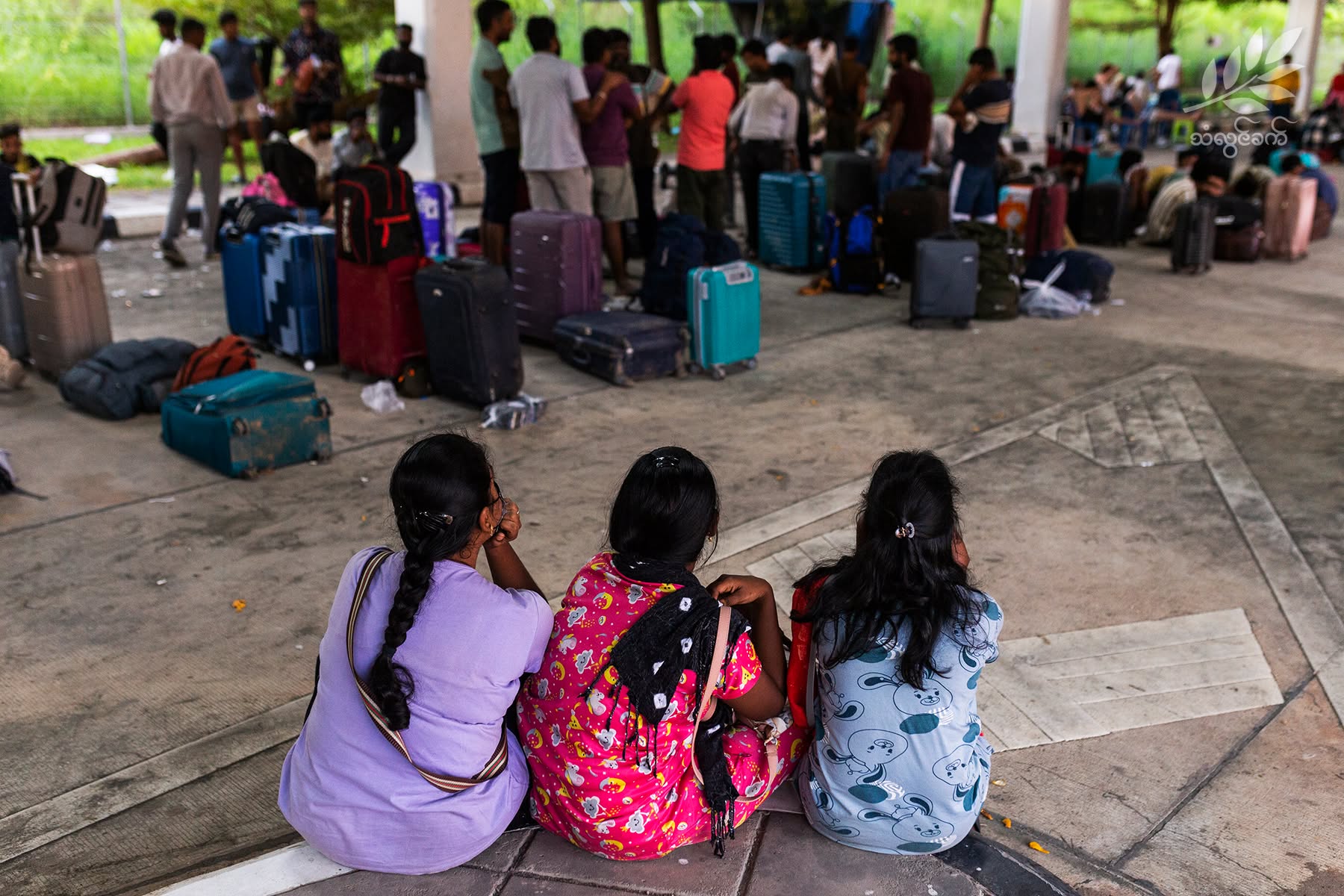
Today, within the enclaves of Myawaddy Township situated inside Brigade 6 territory, thousands of Myanmar youths aged between 18 and 35 are trapped. They have been absorbed into an entire auxiliary ecosystem, working as construction laborers, kitchen staff, security guards, translators, and sex workers.
The financial gravity of a shadow economy
For the youth of a dying economy, the financial gravitational pull of the compounds is nearly impossible to resist. Following the coup, many youths who fled across the border into Thailand struggle to survive as basic laborers on roughly 200 Thai Baht (THB) a day due to strict labor laws. Conversely, a construction laborer inside a cyber scam compound earns 300 THB a day, and a basic security guard can expect a minimum monthly salary of 6,000 THB (roughly one million Myanmar Kyat). For those possessing IT skills or fluency in Chinese and English, monthly earnings jump to between 30,000 and 50,000 THB (approximately three to five million Kyat). When contrasted with Myanmar’s domestic economy, where young professionals earn a maximum of roughly 400,000 Kyat a month, the disparity is staggering.
“Over there, they are making 2.9 or 3 million Kyat a month. When they come back here and have to struggle to make it through the month on 300,000 or 400,000 Kyat, they can’t handle it anymore. That’s why there are so many who say they will never scam again but end up going back for a second time,” said Ko Myo, who observes the situation of the youth.
Human trafficking and the digital snare
This vast income asymmetry has transformed an entire generation into a premium target for human trafficking syndicates. On platforms like Facebook, TikTok, and Telegram, deceptive job advertisements promising lucrative roles are posted daily. Recruiters who deliver a new person to a compound gate receive broker fees ranging from 500 THB to 15,000 THB, intensifying the predatory recruitment apparatus.
While a segment of youth enters these zones clear-eyed about the criminal nature of the work, many others are lured under the pretense of legitimate administrative employment, only to discover they have been sold into modern slavery. Minors aged between 13 and 16 are routinely absorbed into the workforce, while young women face particularly bleak conditions, navigating the threats of forced prostitution or being sold as forced brides.
Ko Wanna remembers his final phone call, nearly a year ago, with a close female friend who disappeared into one of the Myawaddy enclaves: “She was terrified. She told me, ‘If I stay here any longer, they are going to force me to marry one of these Chinese bosses.’ The next morning, her phone went dead. Her family has not heard a single word from her since.”
The UN Human Rights Office (OHCHR) estimates that at least 120,000 people across Myanmar are currently being forced to execute online financial fraud. These cybercrime operations have established deep roots along Myanmar’s frontiers—from Shan State to Karen State—existing almost exclusively in territorial pockets controlled by localized armed factions. Highly fortified enclaves in Myawaddy Township, such as Shwe Kokko, KK Park and Huanya Park, are among the most notorious hubs.
While regional data rarely isolates Myanmar nationals into a single column, ground assessments indicate that local youths now constitute a staggering baseline of the workforce, making up anywhere from a significant minimum to roughly 50% of the staff in individual compounds. This reality was underscored in October 2025 during a raid on a syndicate in KNU-controlled Min Lat Pan, which revealed that out of the 4,000 workers detained, exactly half 2,000 individuals were young citizens of Myanmar.
The crisis reached a tipping point after February 2024, when the military junta activated the People’s Military Service Law. Independent monitoring networks estimate that by mid-2026, the junta has forcibly conscripted more than 120,000 young people. Desperate to avoid being deployed as frontline combatants or human shields, a significant portion of local youth fled toward the borders, walking directly into the traps set by cybercrime recruiters.
The warlords and the shadow economy
The survival of these syndicates depends entirely on the protection of local warlords. Factions operating along the border, including the Karen Border Guard Force (rebranded as the Karen National Army) and the DKBA, generate astronomical revenue by leasing land and providing security to transnational kingpins.
“These camps are secured by the DKBA. When the Chinese go out, they have to follow behind as bodyguards,” confirmed U Soe, a local leader, based on what he has seen.
Despite targeted international sanctions leveled against border militia leaders and attempts to sever electricity and internet cables, the syndicates have proven remarkably adaptive. The compounds now run on Starlink satellite arrays and bypass the international banking system entirely by routing hundreds of millions of dollars through cryptocurrency networks.
Inside the wire
For those trapped behind the reinforced concrete walls and razor wire, life is defined by a complete absence of human rights. Those who refuse to participate or attempt to escape face severe torture. Victims face immediate debt bondage, their passports or National Identity cards are seized, and they are subjected to grueling 19-hour shifts under constant armed surveillance. Those who fail to hit their daily financial targets face salary forfeiture, starvation, solitary confinement, and severe physical beatings.
A close person with the medical field within the Myawaddy border zone describes the grim reality; “I heard that they torture them until they are on the brink of death. They only send them to the clinic when the situation is completely beyond recovery. I remember that one medical person said a patient who looked at him and said, ‘Even if you save me, they will just torture me again when I go back. Just let me die.”
Highly infectious diseases like Tuberculosis (TB) are tearing through the tiny, packed rooms, yet managers consistently prioritize operational uptime over basic human survival.
Civil society activist Naw Lar Shee described the changing attitudes of the youth: “Selfishness takes over them just to get money, and they will treat a person dying just like a small chicken or bird dying, and just keep on doing it.”
The nomadic shift
Faced with mounting international pressure, the military junta and its allied border militias staged a series of crackdowns at prominent hubs like KK Park and Shwekokko. Commenting on their efforts, the former Myanmar junta’s spokesman Gen Zaw Min Tun stated, “We are working to completely eradicate online scam activities from their roots.”
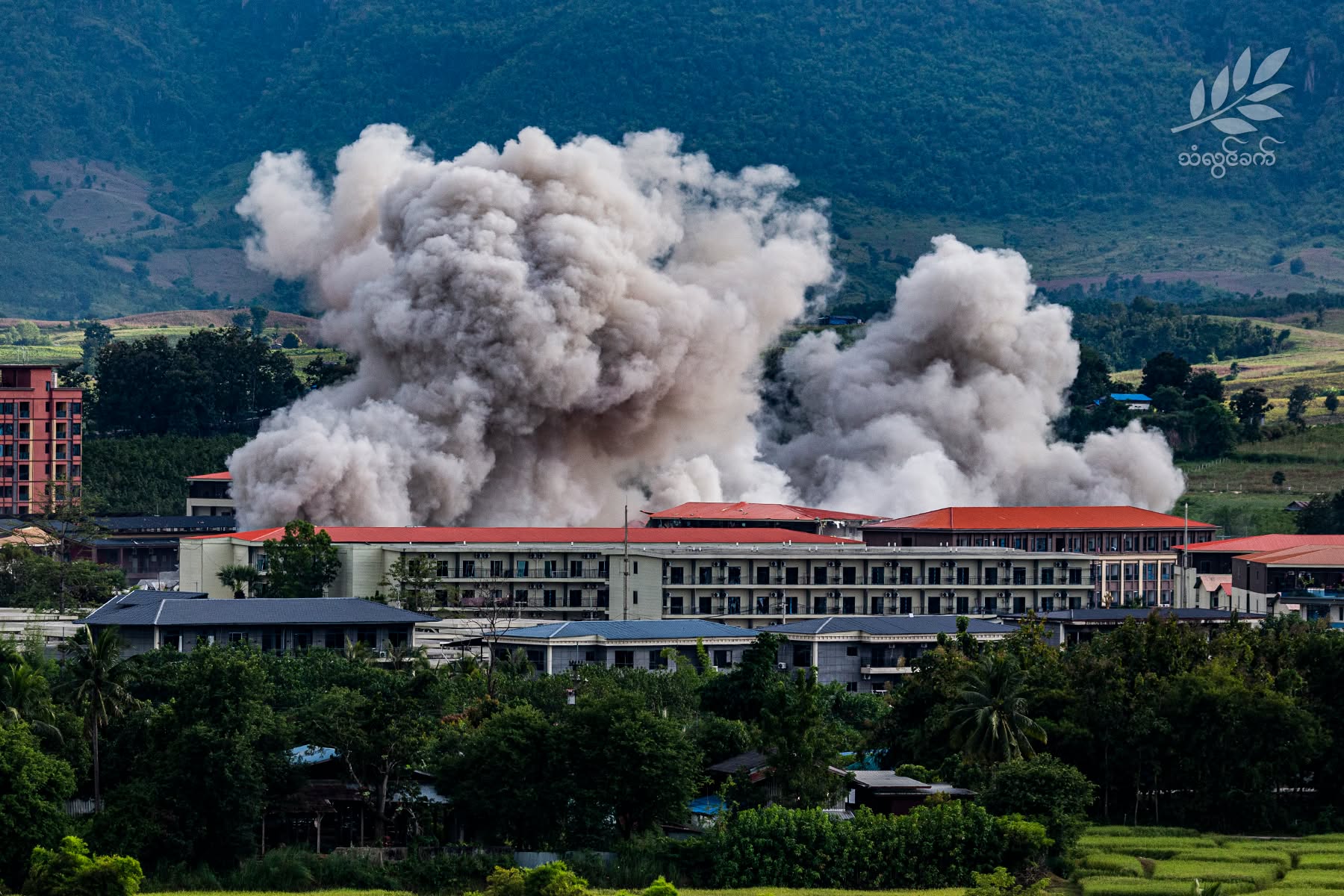
In late 2025, junta forces raided KK Park, detaining over 2,000 individuals and staging the demolition of 635 buildings within the complex. Yet, despite these highly publicized, superficial crackdowns at prominent hubs like KK Park and Shwekokko, compound operators invariably received advance notice, allowing them to swiftly relocate their operations to alternative sites.
“The industry has simply gone nomadic,” says a male laborer currently working inside the network. “They don’t keep the major sites on the flat plains near the border anymore; everything has shifted up into the mountains.” Local interviews and field inspections confirm that in the first half of 2026 alone, no fewer than 20 new scam outposts have quietly opened across remote mountain villages like Thay Baw Boe and Waw Lay, fortified with military-grade bunkers.
Seeking a way out
Rights advocates and legal experts argue that treating the youth trapped in this system as criminals is a fundamental misdiagnosis of the crisis.
Dr. Sai Kyi Zin Soe advises, “What is important is that the military government needs to immediately halt the conscription law. It is crucial not to criminalize the youths who are forced to participate. Only the major investors should be punished and penalized.”
As former Member of Parliament U Ye Min Zin points out, any permanent resolution to the border crisis remains inextricably bound to Myanmar’s broader civil war. The shadow economy can only be dismantled if the corrupt military apparatus and the border militias that shield it are entirely uprooted.
But for young men like Ko Kaung, waiting for structural political change is a luxury of the safe. For now, the fortified compounds of Myawaddy remain a grim, inevitable destination; the only remaining exit for a generation left with everything to lose and nowhere else to go.
“If I walk out of these gates tomorrow, I have absolutely nothing,” Ko Kaung says quietly. “I can’t even begin to imagine another choice.”
This investigative report was supported by the Thomson Reuters Foundation mentoring programme.